
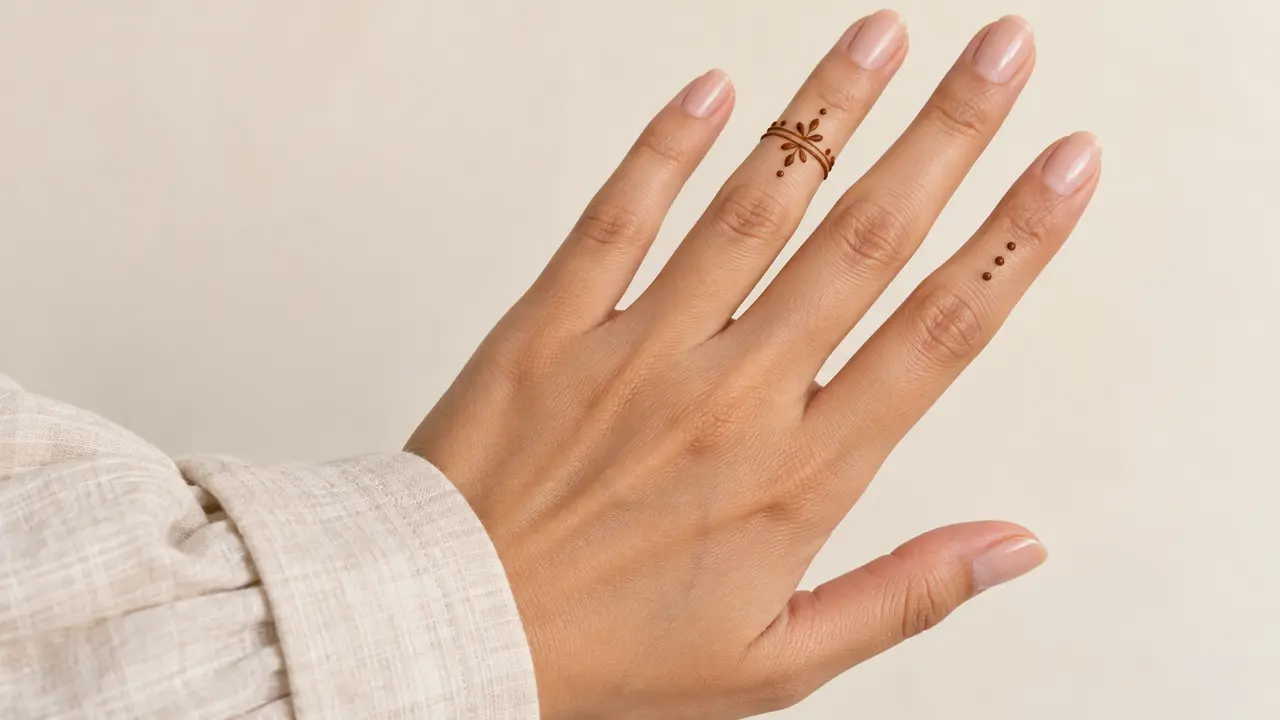
Why a Finger Design Looks Different from One on the Hand
A finger is a narrow, curved and mobile surface. This makes a considerable difference when choosing a henna design. A composition that looks beautifully spaced in an enlarged photo may appear cramped when you look at the hand normally. Joints, the spaces between fingers and movement also create visual breaks.
For this reason, the best choice is not necessarily the finest design. A single line, a row of dots or a carefully positioned small leaf can look far more considered than densely packed decoration. Before imagining the details, ask yourself what you want to highlight: the length of a finger, the area near the nail, a single finger segment or the whole hand.
You can think of the design as flexible jewellery: a ring-like shape recalls a band, a central line suggests a chain, and two small branches can frame the skin like an ornament. These are aesthetic comparisons, not motifs dictated by any single tradition.
Six Ideas for Finger Compositions
The open ring consists of two short sections arranged around a finger segment, leaving a deliberate opening. It draws attention without creating a thick circle. A second line can make it more prominent, but the gap between the two lines must remain visible.
The central line runs along the length of the finger. It can end in a dot, leaf or tiny flower. If the hand already has other elaborate designs, this line brings a sense of order.
Graduated dots start with a larger dot and progress to increasingly smaller ones. The eye naturally follows this progression. To avoid a blotchy effect, leave real gaps between the elements.
The vertical leaf is a small elongated silhouette placed on a finger segment. It works well by itself. Veins are optional: at this scale, they can sometimes make the motif look heavy.
The half-frame draws two curves along the sides of a finger rather than a line down the middle. It leaves the centre clear and creates a delicate impression.
Alternating decorated and undecorated fingers is a composition conceived for the whole hand. Instead of repeating the same motif on five fingers, you can decorate two and leave the others bare. The contrast then becomes part of the style.
Choosing Where to Start and Stop
A design can sit near the base of the finger, in the middle of a finger segment, close to the nail or along its entire length. None of these options is universally better. They simply produce different effects. A band at the bottom of a finger recalls jewellery; a line near the nail draws attention towards the fingertip; a succession of patterns covering the finger makes a stronger statement.
Also consider the other items you wear. With several real rings, a highly decorative design may create an overly busy impression. A small motif that leaves room for jewellery can sometimes be easier to appreciate. Conversely, without jewellery, a more elaborate design can become the main feature.
Good to know: on a curved surface, a line drawn perfectly straight when flat can appear slightly off-centre depending on the viewing angle. This is an ordinary perspective effect. Assess the composition from the front and then with your hand relaxed, rather than judging it solely from a very close-up photograph.
Comparing Styles Before You Choose
| Style | Overall impression | Suggested area | Watch out for |
|---|---|---|---|
| Drawn-on ring | Jewellery effect | One finger segment | Excessive thickness |
| Central line | Visually lengthens the finger | Length of the finger | Alignment |
| Spaced dots | Light and contemporary | Near the nail or base | Dots merging |
| Single leaf | Natural and gentle | Middle of a finger | Overly fine detail |
| Half-frame | Delicate | Sides of the finger | Design barely visible from some angles |
| Two decorated fingers | Elegant asymmetry | Whole hand | Unintentional imbalance |
This table is not a list of “good” and “bad” designs. It helps you visualise the options quickly. If you love very dense ornamentation, you can certainly wear it: simply bear in mind that it will look different from a pared-back style.
Designing a Hand Without Covering Everything
A hand looks more harmonious when the designs share an element. This might be a repeated set of three dots, the same leaf shape or a similar line direction. You do not need exactly the same drawing on every finger. On the contrary, a small variation can add rhythm.
Imagine two compositions. In the first, every finger has a thick ring, three leaves, two flowers and a line. The eye no longer knows where to look. In the second, the index finger has a fine branch, the middle finger an open ring and the ring finger three dots. The details differ, but they share the same simplicity. The second composition is often easier to read.
Also consider how the fingers relate to the back of the hand. If the back of the hand already features a large flower, you can extend its direction towards one finger rather than starting another unrelated motif. For a closer look at this overall arrangement, the guide dedicated to the back of the hand will be more relevant.
Using Photographs as a Real Decision-Making Tool
Do not choose your design solely from an image cropped around a finger. Ask to see the entire hand as well. A motif may look delicate in isolation but unbalanced in the overall composition. Notice how the fingers come together, whether the hand is wearing rings and which areas remain clear.
A serious inspiration collection should show both views: a close-up of the lines and a wider photo explaining the design's placement. That is why the visuals for this article will be conceived in pairs, rather than as a collection of beautiful images without explanation.
This page deals with aesthetic choices and placement. If you want to know how to handle the applicator, how much pressure to use or how to correct smudges, consult the corresponding application tutorials: they address a different question.
Frequently Asked Questions
Can I decorate just one finger?
Yes. A single design can become an elegant detail. It is often easier to coordinate with an outfit and other jewellery.
Do I need to decorate all five fingers?
No. Decorating just the index and ring fingers, for instance, creates a different rhythm from covering them all.
Which pattern creates a ring effect?
Two arcs or a small open ring around a finger segment suggest a ring. A visible opening can prevent it from looking like an overly heavy band.
Why does my design look too busy?
It may contain too many closely spaced elements for such a narrow area. Try removing one ornament and keeping a clear overall direction.
Explore More
Sources and Methodology
- The Metropolitan Museum of Art — Woman Applying Henna: an example of historical documentation of henna practice, without claiming that the image validates contemporary designs.