
Choosing a First Design You Can Manage
Sometimes all it takes is seeing a photograph of an intricate mehndi design to want to recreate the entire composition. Yet this kind of pattern brings together several skills: keeping lines consistently thick, repeating shapes, maintaining spacing and anticipating what will remain visible once the paste is removed. For a first attempt, it is better to begin with a single idea you can understand in seconds.
A good beginner’s design has three qualities. First, you can sketch its basic structure on paper without needing a complicated reference. Second, it still looks attractive even if the lines are not exactly alike. Finally, it leaves enough room around the shapes to avoid a muddled result. A minimal design is not an impoverished one: its appeal lies precisely in the balance between its elements.
Before choosing, look at the area where you would like to wear the design. A finger offers little space, and tightly packed details are difficult to make out. On the back of the hand, a small isolated design can appear lost if you had imagined it as a central piece of jewellery. On the wrist, an elongated composition naturally follows the line of the arm. These are observations about aesthetics and visual comfort, not absolute rules.
Ten Practical Ideas, from the Simplest to the More Elaborate
1. Three dots forming a triangle. Place one dot slightly higher, with two spaced apart beneath it. The triangle has a graphic presence without being a solid shape. It works near the base of a finger or on the side of the wrist. The challenge is spacing: three dots too close together become a blotch.
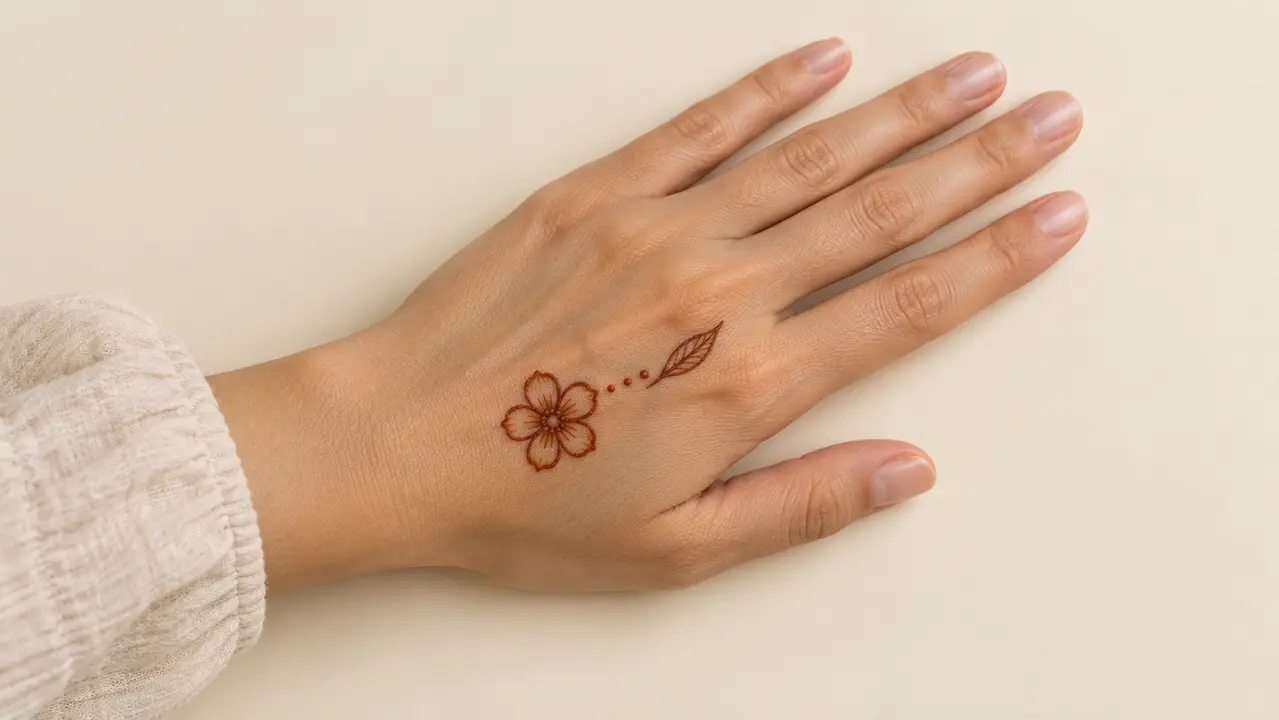
2. A small five-petalled flower. Imagine a central dot surrounded by five rounded petals. Keep each petal clearly separate; there is no need to add veins straight away. Position the flower on a relatively flat area, such as the back of the hand.
3. A curved branch with three leaves. Picture a simple stem, then arrange three leaves alternately along it. This shape is easier to adapt than a large bouquet. It lends itself to a lengthwise design on the wrist.
4. An open ring. Two short arcs on either side of a finger suggest a drawn-on ring, without trying to close the circle perfectly. The opening can be the most elegant detail in the composition.
5. Two facing leaves. One leaf on the right and one on the left, with a small gap in the middle: the symmetry is easy to read and compare visually. The pitfall is adding too many details inside the leaves.
6. A standalone crescent moon. Its simple silhouette allows it to stand alone. Choose enough thickness to prevent the outer and inner curves from visually merging.
7. A chain of five dots. The dots can gradually decrease in size to give the pattern a direction, from largest to smallest. On a finger, this idea is often clearer than a long continuous line.
8. A fine wave. A smooth curve evokes movement. To keep it decorative, avoid making it zigzag every few millimetres. Place it along the side of a hand or lengthwise on the wrist.
9. A diamond with a central dot. The geometric outline is instantly recognisable. The dot inside gives the whole design a centre without overcrowding it. It is a good alternative to floral motifs.
10. A miniature asymmetrical bouquet. Combine a main flower, a smaller flower and a leaf. This tenth idea requires more decisions: the relative importance of the sizes, the direction of the stems and the breathing room between elements. It is suitable once the preceding nine ideas feel straightforward.
Quick Selection Table
| You are looking for… | Suggested design | Possible placement | Watch out for |
|---|---|---|---|
| An almost invisible design | Three or five dots | Base of a finger | Dots too close together |
| A romantic touch | Simple flower | Back of the hand | Petals touching |
| A jewellery-like effect | Open ring | Finger joint | A ring drawn too tightly |
| An elegant line | Branch or wave | Wrist | An overly uneven curve |
| A geometric style | Diamond | Back of the hand | Indistinct angles |
| A first combined design | Miniature bouquet | Back of the hand | Not enough space |
This table does not rank designs by beauty: it simply helps narrow down the choices. If you prefer straight lines to curves, a diamond may seem easier to you than a flower, even if other people feel the opposite.
What Makes a Small Design Truly Successful
The visual secret of a small design is not the number of details. It is the relationship between the drawing and the empty space around it. Imagine a flower on the back of the hand: if you add four branches, three lines and dots everywhere, the flower stops being the centre. If you keep just one leaf and two well-spaced dots, the eye immediately understands what matters.
Scale also deserves attention. A photograph taken very close up makes tiny strokes look appealing; on a hand viewed from a normal distance, those details sometimes blend together. To choose your design, look at the composition at a small size on your screen, then at approximately the size it will actually be.
Key point: an easy design is one you can simplify without losing its character. Before working with paste, try drawing it on paper in ten seconds. If you do not know which element comes first, revisit the idea in a simpler form.
Finding Inspiration Without Copying an Entire Artwork
A design seen on social media can give you an idea for placement, rhythm or contrast. That does not mean you have to reproduce a specific composition. Pick just one detail: a leaf shape, the way dots are spaced or a flower placed to one side. Then change the format or combine the idea with a more personal shape.
It is important to distinguish general cultural inspiration from a design signed by an artist. Traditional motifs have circulated through varied histories, but a particular contemporary creation may be protected. For the images on this page, we will therefore create our own examples rather than redrawing an illustration found on Pinterest.
Finally, do not expect your first designs to be perfectly symmetrical. A slightly irregular little branch can remain charming. If, however, you want a flower with five petals of exactly equal size, prepare a sketch first: repetition requires more attention than a single stroke.
Going Further Without Mixing Everything Together
This page helps you choose a design, not learn every aspect of handling a cone. For application, how the paste behaves and the first techniques, consult the specialist guides. If you are mainly looking for a variety of images, the site's long-standing gallery is still the right starting point.
For your first design, choose one shape, one placement and just one secondary decoration. Once you have seen the result, it will be easier to identify what you want to change: make the flower larger, lighten the lines or move the design towards the wrist. That is how a personal style begins to emerge.
Frequently Asked Questions
Which design should I choose for my very first attempt?
Three spaced dots, a small flower or a diamond are easy to understand visually. Above all, choose a shape you can redraw on paper without hesitation.
Can a simple design look elegant at a celebration?
Yes. A discreet design can complement an elegant outfit beautifully. Where the design is placed and how much space surrounds it often matter more than the number of details.
Do I need to reproduce a photograph exactly?
No. A photo can serve as a reference for placement or size. You can create your own composition by changing the proportions and elements.
Why can two small flowers create different effects?
Size, spacing, petal orientation and placement on the hand change how the design is perceived. A central flower attracts more attention than one near an edge.
Sources and Methodology
- The Metropolitan Museum of Art — Woman Applying Henna: an example of historical documentation of henna practice, without claiming that the image validates contemporary designs.