
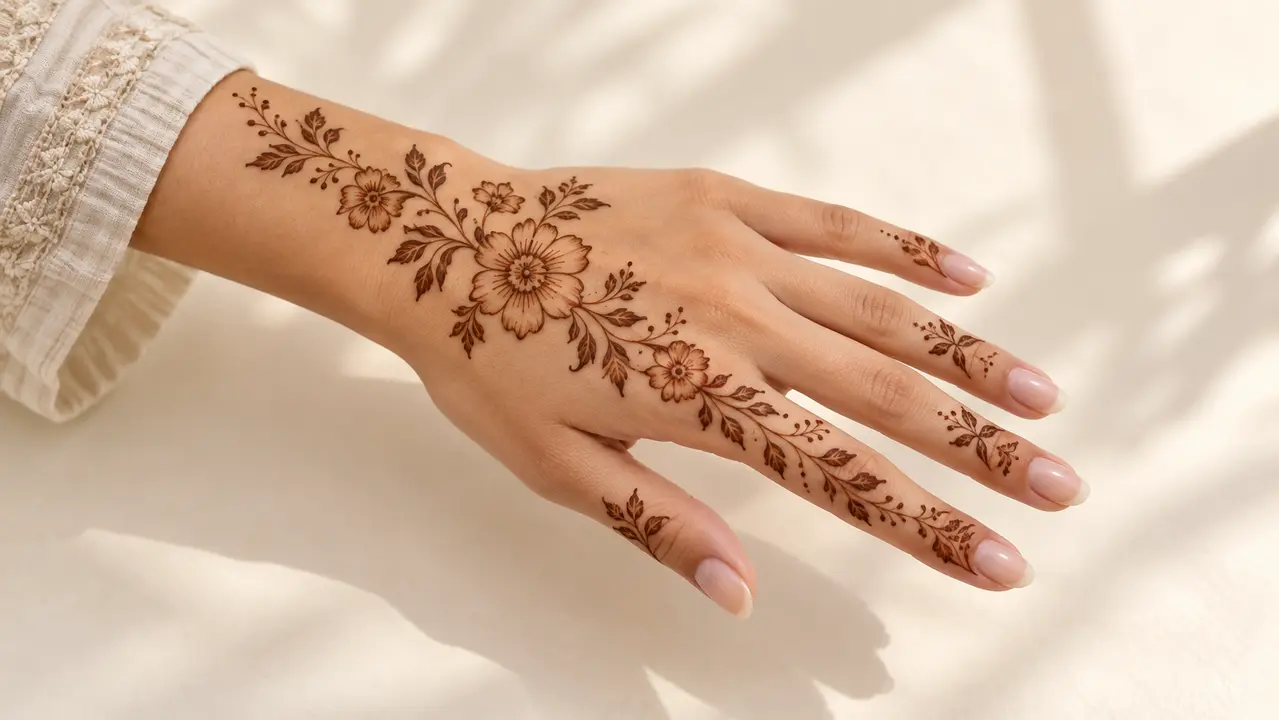
Why Flowers Work So Well in Mehndi
Flowers are easy to recognise, even when highly stylised. A few petals around a centre are enough to suggest a flower; a curved line and two leaves are enough to suggest a branch. This recognisability explains why botanical patterns can be very simple or become extremely rich without entirely losing their identity.
In the world of mehndi, we often see repeated flowers, small leaves arranged along lines and compositions that seem to grow from one point towards another. However, we should not imagine there is a single “official” flower or one floral style that applies to every country. Traditions, artists and eras have produced many different ways of using botanical elements.
On an inspiration page, the aim is to help you observe how these elements work together. A large flower can become the main subject; a series of small leaves can connect two parts of the hand; tiny petals can create a border. These are graphic roles, not automatic cultural meanings.
Four Shapes That Change Everything
The round flower acts as a central focal point. Its petals spread out around a visible centre. If you want a readable composition, maintain a clear distinction between that centre and the outlines.
The fan-shaped flower does not necessarily form a complete circle. Its petals open in one direction and can follow the edge of a hand or the curve of a wrist.
The branch with alternating leaves acts as a connection. It is useful because it directs the eye without taking up as much space as a row of flowers.
The stylised rosette combines several layers of petals or arcs. It creates richness but requires particular care with spacing. If the layers touch too much, the result resembles a dark disc rather than a detailed flower.
These groups should not be treated as a scientific classification of mehndi. They are simply a tool for comparing designs and understanding their visual effects.
Building a Composition Around a Main Element
Imagine three choices for the back of the hand. In the first, a flower occupies the centre and a few leaves extend towards the wrist. In the second, a branch climbs diagonally with three flowers decreasing in size. In the third, a frame of small leaves surrounds a large empty space. All three use the same ingredients, but each tells a different visual story.
The difference lies in hierarchy. A large flower attracts the eye. Three flowers of equal size create more of a rhythm. A botanical border makes the undecorated skin the centre of the composition. No arrangement is inherently better; the choice depends on the effect you want.
A useful observation exercise is to cover the details of a photograph with your finger and look only at the overall silhouette. If you can identify a centre, a diagonal or a border, the composition probably has a readable structure. If everything looks the same throughout, the design relies more on density than on a focal point.
Combining Flowers Without Creating a Confusing Design
The classic pitfall is accumulating different varieties: a stylised rose, a suggested lotus, daisies, small five-petalled flowers, arabesques and several borders, without deciding how to connect them. This mixture can work in a highly elaborate artwork, but it requires strong consistency in lines and proportions.
For a simpler personal design, choose no more than two families of shapes: for example, a round flower and a small elongated leaf. Then repeat these shapes with a few variations in size. Their similarities will naturally create a common thread.
Remember to give the petals room to breathe as well. A flower drawn with five separate petals can become less readable if you fill every space between them. In a dense composition, by contrast, you will need to organise filled and empty areas so the pattern retains contrast.
Quick Guide to Reading Floral Patterns
| Element | Common role in the design | Graphic effect |
|---|---|---|
| Large round flower | Focal point | Draws attention |
| Repeated small flower | Rhythm | Connects areas |
| Flowing branch | Direction | Follows the body's shape |
| Alternating leaves | Transition | Fills space without creating a solid block |
| Multi-layered rosette | Rich central ornament | Adds density |
| Botanical border | Frame | Highlights the central space |
This table describes visual functions. It does not assign religious, marital or spiritual meaning to these flowers. Such interpretations must be documented for a specific context rather than generalised to everyone who wears henna.
Floral Designs Can Also Be Modern and Minimalist
Floral mehndi is sometimes assumed to mean an elaborate design. Yet a single flower on a finger, a branch on the wrist or three petals on the back of the hand can create a very contemporary aesthetic.
Modernity does not come from a “new” motif in isolation, but from its presentation: size, placement, the space surrounding it and the choice to decorate only part of the hand. A stylised traditional flower can become a contemporary detail when placed on its own, without a border or filled background.
If you enjoy this restraint, the guide to minimalist henna explores precisely that question in greater depth. To discover other placements, the pages on fingers, wrists and the back of the hand show how botanical shapes adapt to different surfaces.
Frequently Asked Questions
Does a henna flower always have a meaning?
No. Certain interpretations exist in particular contexts, but no universal meaning can be assigned to every stylised flower.
Can I combine flowers and geometric shapes?
Yes. A border of small diamonds can surround a flower, provided both families of shapes remain recognisable.
How can I avoid an overly busy floral design?
Choose one main flower, limit the number of petal styles and leave visible spaces between the ornaments.
Does a floral mehndi design have to cover the whole hand?
No. A single branch or flower may be enough, depending on your style and the occasion.
Explore More
Sources and Methodology
- The Metropolitan Museum of Art — Woman Applying Henna: an example of historical documentation of henna practice, without claiming that the image validates contemporary designs.