
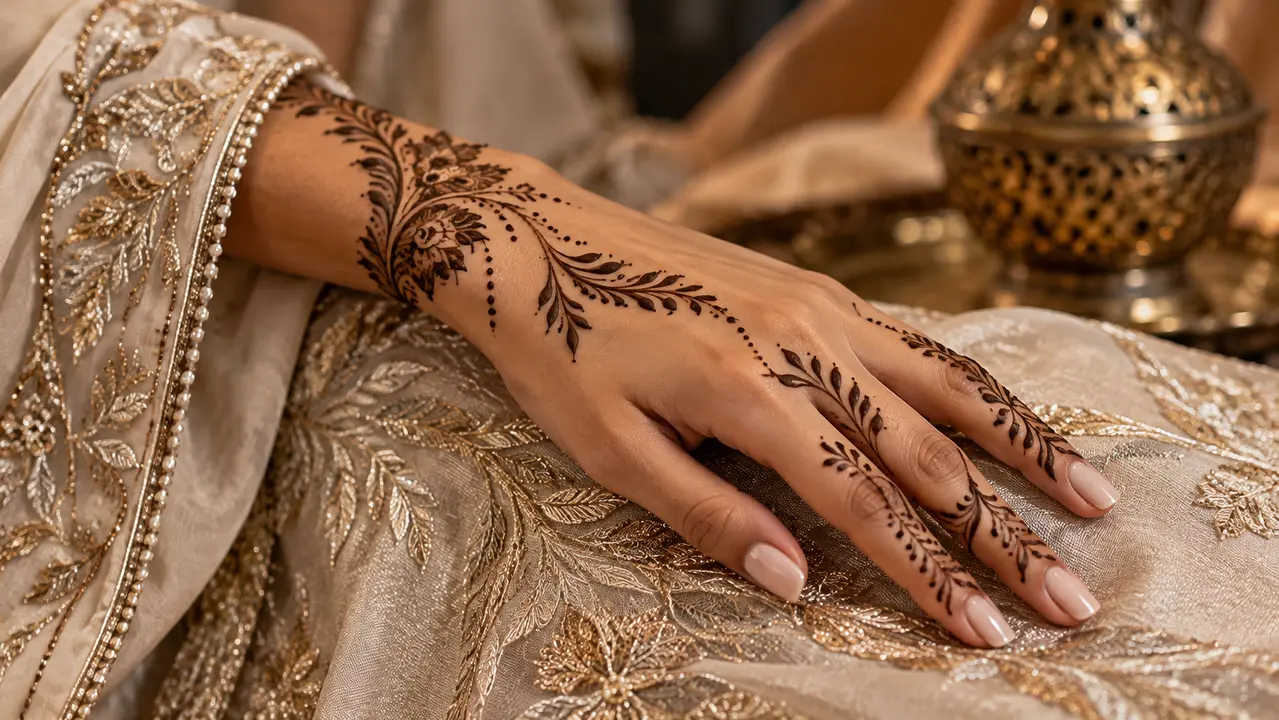
From the Emirates and Saudi Arabia to Oman, henna is part of beauty and festive traditions. Yet speaking of a single “Gulf style” would erase the differences between practices.
A Tradition of Celebration
Henna can accompany weddings, festivals and social gatherings. These practices are documented, among other sources, in UNESCO's collective file on henna rituals.
An Evolving Aesthetic
Floral compositions, full-coverage designs and more open patterns can all be found. Contemporary tastes, artists and social media spread inspiration across borders.
The Importance of Craftsmanship
Preparing henna and applying designs are skills passed on through observation and practice. Today, they may also be learned from artists and in specialised settings.
Interpreting an Image Carefully
A photograph captioned “Gulf henna” proves neither its origin nor a tradition shared by every country. When describing a local custom, a specific source is more useful than an aesthetic label.
Gulf Inspiration Is Not a Single Style
Designs associated with Gulf countries may emphasise floral lines, airy compositions or denser patterns, depending on the place, period and preferences. We should avoid calling any design that resembles a social media post “traditional Gulf henna”. In visual examples, “contemporary inspiration” is a better description when there is no source supporting a precise regional attribution. This transparency protects readers and respects the richness of these traditions.
Why Speak of “Gulf Countries” in the Plural?
Gulf countries share certain decorative practices, but they do not form a single cultural community. Henna may be used at celebrations, family gatherings or for beauty purposes, with differences depending on country, family and generation. Claiming that all Gulf designs resemble one another would erase that diversity.
The collective UNESCO inscription of 2024 includes, notably, the United Arab Emirates, Bahrain, Kuwait, Oman, Qatar and Saudi Arabia. The recognition describes henna as an aesthetic and social practice and highlights the transmission of skills. It does not rank styles or establish a single “Gulf recipe” applicable everywhere.
Looking at Compositions Rather Than Labels
A floral composition may convey fluidity through repeated leaves and curved lines. More strongly contrasting lines may organise the hand differently. Some contemporary designs emphasise the back of the hand while leaving parts of the skin visible. These are useful descriptions, but not proof of provenance.
When a photograph is presented as “Gulf henna”, ask who published it and in what context. Is it an artist's portfolio, a family photograph or an advertisement? An image's style alone cannot establish where it was created. Hennediscount captions must therefore use the words “inspiration” and “style” carefully, without claiming unverified authenticity.
Tradition and Trend Are Not Separate Worlds
An artist may learn techniques from a relative and later use contemporary tools, visual references and presentation styles. A bride may prefer a light design while her mother favours more elaborate decoration. Such differences do not prevent the sharing of skills. What matters is describing people and their choices, rather than sorting motifs into two simplistic categories: “old” and “modern”.
Social media images often show a highly polished final result, sometimes retouched, cropped or lit to emphasise contrasts. They do not replace an understanding of the product being used or of application times. That is why an editorial website must distinguish between aesthetic inspiration, application advice and cultural information.
A Comparison to Help You Choose a Style
Imagine two compositions: one covers much of the fingers and the back of the hand with a network of small shapes; the other uses a few delicate branches rising from the wrist. The first may appear denser and more sophisticated, while the second feels more airy. Neither is intrinsically “more Gulf” than the other. What differs is their visual arrangement.
When preparing a request for an artist, specify the areas to cover, the amount of negative space and the desired level of detail. If you want a particular cultural reference, use images whose context is known and ask whether the artist usually works with that repertoire.
The Skills Behind the Images
UNESCO reminds us that henna skills are also transmitted through practical learning. This matters: a beautiful design is more than an inspiring photograph. Consistent lines, the organisation of decorated areas and adaptation to the body depend on skill and experience. To explore these techniques in detail, consult specialised practical guides rather than attributing them to a supposedly traditional method common to the entire Gulf.
Frequently Asked Questions
Is there only one henna style in the Gulf?
No. Practices and tastes vary widely.
Is henna still used today?
Yes. Traditions coexist with contemporary styles.
Can you identify the country from a motif?
Not reliably from an image alone.
Sources and References
- UNESCO, 2024 inscription decision: https://ich.unesco.org/en/decisions/19.COM/7.B.15 (scope: social practices and their diversity across the 16 participating States, not local details)
- UNESCO, nomination file and community testimonies: https://ich.unesco.org/en/RL/henna-rituals-aesthetic-and-social-practices-02116 (consult country-specific documents before making any local claims)
- UNESCO — Henna: rituals, aesthetic and social practices (2024): https://ich.unesco.org/fr/RL/le-henne-rituels-esthetique-et-pratiques-sociales-02116