In Morocco, henna can be part of festive occasions, particularly wedding preparations. Yet there is no single procedure followed identically by every family.
A Shared Moment
Depending on the circumstances, applying henna may bring together the bride, her relatives and the people responsible for creating the designs. The occasion is as much about conversation and celebration as it is about the finished patterns on the hands.
Customs Vary from Family to Family
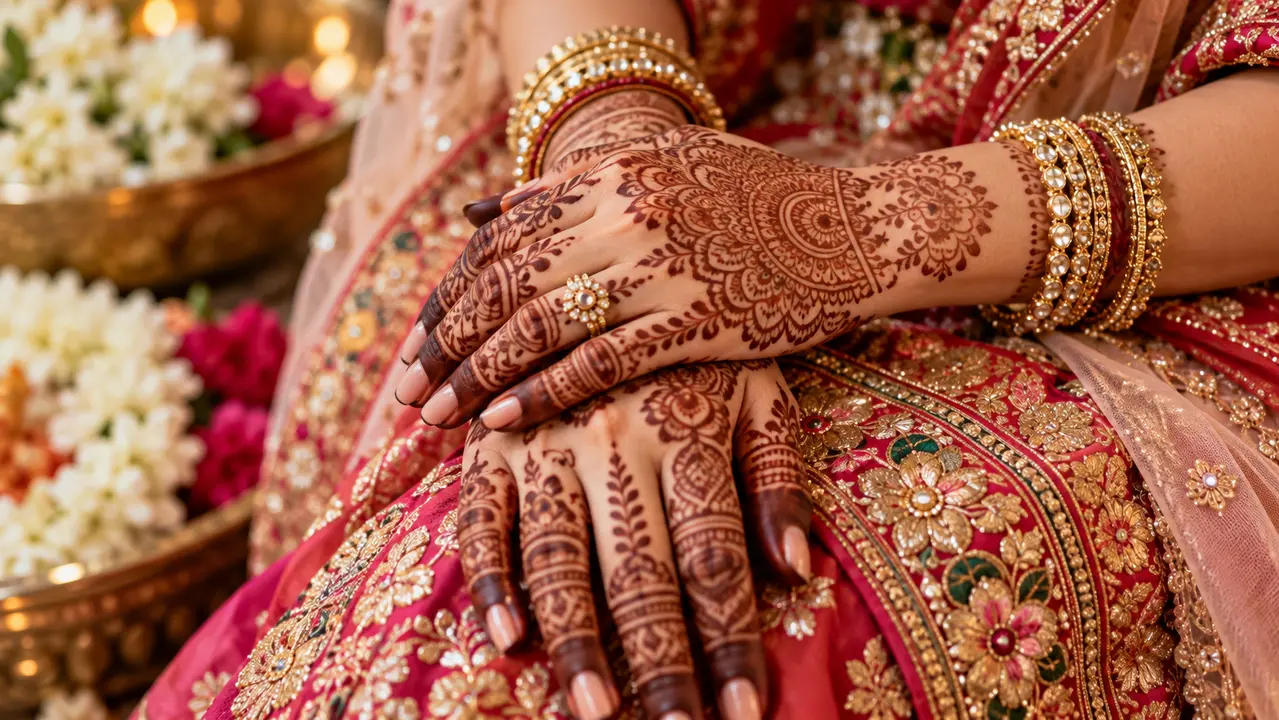
Clothing, songs, decorations, the choice of designs and the place given to the celebration can all vary. A carefully staged wedding photograph therefore shows just one possibility, not a nationwide rule.
The Role of the Designs
Geometric and floral styles can be found, alongside more contemporary compositions. We should avoid assigning a fixed meaning to every line without a specific source or testimony.
A Living Tradition
Some people call on a professional artist, while others prefer an intimate gathering. The tradition can evolve with the bride's tastes and still remain an opportunity for passing on knowledge.
What a Ceremony Photograph Cannot Tell Us
An elaborately decorated scene featuring a tray, cushions and ornaments may depict one possible celebration, but it is not the norm for all Moroccan families. To understand the occasion, it is more useful to ask who takes part, when the henna is applied and what that moment means to those present. An AI-generated image cannot replace such first-hand accounts. On Hennediscount, generated scenes must be captioned “inspirational illustration” and must never be presented as authentic photographs of a ceremony.
What “Henna Ceremony” Really Means
The expression can suggest that there is an official Moroccan ceremony, with a list of steps performed in an unchanging order. In reality, it encompasses social practices. For some families, the occasion is intimate: a relative applies henna, those attending talk, and the festivities continue. For others, the session forms part of more elaborate preparations, involving special clothing, music and decorations. This is not a distinction between an “authentic” ceremony and a “modern” one: these are different ways of celebrating an occasion.
To understand what you are looking at, begin with three questions: does the scene concern a bride-to-be or another celebration? Is it showing the application of henna or the celebration surrounding it? Are the people photographed following a family custom, or posing for a wedding album? A photograph alone cannot answer these questions, which is precisely why overly categorical captions should be avoided.
Preparation Time: An Often-Overlooked Detail
A design does not appear instantly. Preparing for it can take time: finding someone skilled at applying henna, choosing a style, arranging the space and allowing a period during which the hands can remain relatively still. During a celebration, these practical constraints influence how events unfold. There is no need to invent a sequence of rituals to explain what happens: the time devoted to decoration, the help offered by relatives and the way people celebrate already matter greatly.
For example, a highly detailed composition may require a longer session than a light decoration on the fingers. The choice may depend on the schedule, the bride's comfort and her personal wishes. The importance of henna within the celebration therefore cannot be measured by the number or complexity of its designs.
Three Ways to Explore Styles Without Caricaturing Them
Geometric lines rely on repetition, contrast, and areas that are filled in or left bare. Their visual appeal lies as much in their arrangement as in the shapes themselves. Floral compositions favour leaves, curves and the continuity of lines. Contemporary creations may combine different influences and focus on just one part of the hand.
These categories describe visual characteristics, not absolute regional rules. Saying “this design is Moroccan because it is geometric” would be jumping to conclusions. A motif can spread, evolve or be reinterpreted by an artist. For readers looking for inspiration, describing the composition—dense or airy, symmetrical or not, centred on the palm or fingers—is more helpful than promising an origin that cannot be demonstrated.
How to Describe This Tradition Accurately
In a cultural article, a clearly situated account is often worth more than a dramatic generalisation. “In this family from Fez, the participants chose...” can be verified if there is testimony to support it, unlike “In Morocco, all brides must...”. When the place, date or community is unknown, Hennediscount must stick to general observations: henna accompanies celebrations and encourages interaction among loved ones, but its forms vary.
The collective UNESCO inscription of henna in 2024 provides important context: it highlights skills, knowledge and social practices passed down in several countries, including Morocco. It does not certify every symbolic interpretation found on social media. Recognising this distinction allows us to respect the tradition while making it accessible to today's readers.
Frequently Asked Questions
Is the ceremony the same throughout Morocco?
No. Practices vary between regions and families.
Is henna reserved for the bride?
No. It may also be used for other celebrations and beauty practices.
Does every Moroccan motif have a specific meaning?
No. Systematic interpretations should be treated with caution.
Sources and References
- UNESCO, 2024 inscription decision: https://ich.unesco.org/en/decisions/19.COM/7.B.15 (scope: social practices and their diversity across the 16 participating States, not local details)
- UNESCO, nomination file and community testimonies: https://ich.unesco.org/en/RL/henna-rituals-aesthetic-and-social-practices-02116 (consult country-specific documents before making any local claims)
- UNESCO — Henna: rituals, aesthetic and social practices (2024): https://ich.unesco.org/fr/RL/le-henne-rituels-esthetique-et-pratiques-sociales-02116