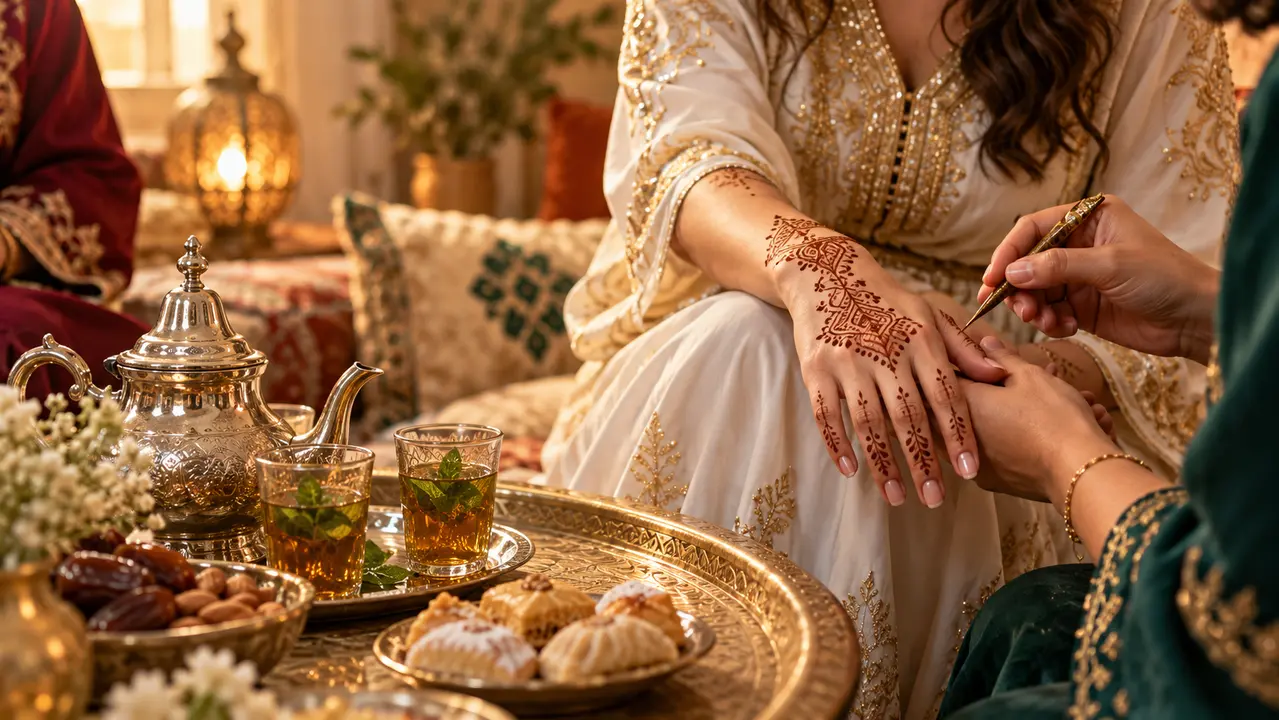
The henna ceremony plays an important part in certain family celebrations in Algeria. It may bring together hand decoration, family reunions and practices passed down through generations.
The Importance of Family Bonds
One notable feature is the presence of loved ones. Henna can accompany a moment of special attention for the person being celebrated, particularly at weddings, although practices vary.
Between Heritage and Personal Choice
Ceremonies may be modest or highly elaborate. Songs, clothing and the way henna is applied also depend on regional and family circumstances.
Different Ways to Wear Henna
Colouring the fingertips and creating intricate designs are different decorative choices. No one style can be presented as representative of all Algerian women.
Describing Traditions Without Freezing Them in Time
To understand a local tradition, listening to the people who practise it is better than generalising from a video. That is what makes these customs interesting: they are still experienced and reinvented today.
Avoiding Shortcuts When Describing Algerian Ceremonies
One family may emphasise a traditional gesture, another an elaborate hand decoration and another a more intimate moment with relatives. Describing only lavish, filmed celebrations would erase this diversity. Photographs and accounts need context: a practice observed at one wedding does not represent every region or generation. Any particular local detail that is added must be supported by identifiable testimony or research.
There Is No Single Model for an Algerian Ceremony
Talking about henna “in Algeria” is convenient for a headline, but insufficient to describe a family. Customs may differ across towns, regions, generations and family histories. Wedding preparations, a celebration with a few relatives and a larger organised gathering do not necessarily resemble one another. Even when a practice has the same name, its place within the event can change.
One useful way to understand these differences is to separate the act (applying henna), the occasion (before a wedding, during a family gathering or at another event) and the meaning described by the participants. These three dimensions are connected but not interchangeable. The same design may be chosen for its beauty in one family and given a particular explanation in another.
The People Matter, Not Just the Ornaments
In accounts of celebrations, the decorated hands, clothes and accessories tend to catch our attention first. Yet an important part of the experience lies in people coming together: who prepares the space, who accompanies the person receiving henna, who passes on the techniques and who shares memories? These are practical questions that help us understand the social dimension of a traditional practice.
We should also avoid assuming that knowledge is passed on exclusively by older generations. Someone may discover a design through an artist, their mother, a friend or a video, and then adapt it. UNESCO specifically refers to transmission through observation and practice, which continues in more contemporary settings as well. Such developments do not automatically make a custom less legitimate.
The Designs: Observe Before Interpreting
An elaborate design and a discreet decoration do not necessarily express opposing traditions. The area covered, the shape and the time available all influence these choices. A completely decorated hand immediately catches the eye, whereas a few well-spaced lines may create a lighter impression. Either composition can be beautiful.
When examining Algerian-inspired designs, ask whether the composition favours filled areas, repeated lines, a central feature or a movement towards the fingers. This visual vocabulary is more accurate than assigning an ancestral meaning to every diamond or flower without a source. It also helps when talking to an artist: you can describe the effect you want without attributing to her work a particular tradition that she does not claim.
Three Common Mistakes in Articles About Algerian Henna
The first is to present a luxurious wedding scene as the custom of an entire country. The second is to turn family beliefs or memories into universal religious rules. The third is to systematically oppose supposedly old ceremonies to present-day practices. In reality, customs can coexist and evolve.
Reliable reporting specifies its setting: place, context, people interviewed and date. If this information is missing, the wording should remain modest. This approach does not diminish the beauty of the subject; it simply prevents a generalisation from being passed off as knowledge. In Hennediscount's photographic examples, generated images must be clearly identified as inspirational creations, not as Algerian archival photographs.
A Good Question to Ask a Relative
If you want to understand the place of henna in your own family, ask “How was it done in your family?” rather than “What is the real tradition?”. The answer might involve a person, a song, a meal, an outfit or simply time spent together. Such details often tell us more than a long list of symbols. They show what living heritage really means: practices passed on together with their variations.
Frequently Asked Questions
Is there only one Algerian henna ceremony?
No. There are regional and family variations.
Is henna used only at weddings?
No. Its uses go beyond marriage celebrations.
Is it purely an aesthetic choice?
Not always. Its social and festive aspects also matter.
Sources and References
- UNESCO, 2024 inscription decision: https://ich.unesco.org/en/decisions/19.COM/7.B.15 (scope: social practices and their diversity across the 16 participating States, not local details)
- UNESCO, nomination file and community testimonies: https://ich.unesco.org/en/RL/henna-rituals-aesthetic-and-social-practices-02116 (consult country-specific documents before making any local claims)
- UNESCO — Henna: rituals, aesthetic and social practices (2024): https://ich.unesco.org/fr/RL/le-henne-rituels-esthetique-et-pratiques-sociales-02116