
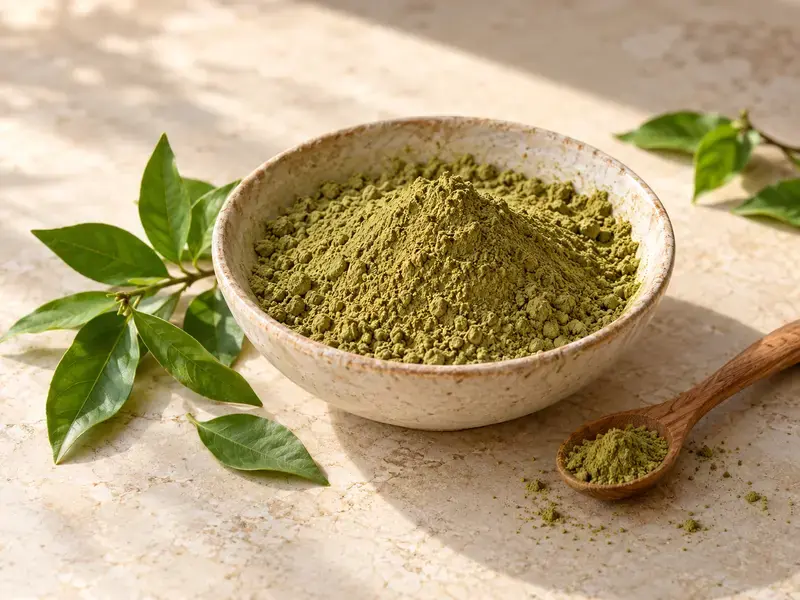
You've come across two packets of henna powder. The first promises “premium quality”, intense colour and professional-level results. The second provides an ingredient list, a batch number and a few storage instructions, but its photographs are less spectacular. Which should you choose?
When it comes to drawing designs on the skin, the answer isn't always found in the product photograph. A powder may look attractive yet be difficult to work with. Conversely, understated packaging may contain a raw material particularly well suited to intricate designs.
The purpose of this guide is simple: to teach you what you can actually check, what you can only assume, and which questions to ask before ordering. We'll look at ingredients, fineness, storage and traceability, without mistaking an appealing marketing claim for a guarantee.
1. The first criterion is the simplest: know what's inside the packet
Genuine henna comes from the leaves of a shrub called Lawsonia inermis. After harvesting and drying, the leaves are ground into powder. This plant material produces henna's characteristic colour. The Royal Botanic Gardens, Kew, clearly identify the plant and its traditional uses.
However, the word “henna” on a packet doesn't prove that it contains only ground leaves. Some preparations combine several plants or include additional ingredients. These mixtures are not all equivalent and are not necessarily suitable for the same purposes.
Before looking at the price, find the ingredient list. If you want pure henna powder, you should be able to identify Lawsonia inermis without having to guess the composition from the product's commercial name. A description such as “secret herbal blend” doesn't allow you to assess precisely what you're buying.
What you've learned: “natural” describes an origin or a claim, not necessarily a simple composition. The ingredient list and the supplier's documentation allow you to investigate further.
2. A powder suitable for fine designs must have a sufficiently consistent texture
Imagine you want to draw a row of tiny dots or a flower with very delicate petals. The paste must flow smoothly from your applicator. If it contains plant fragments that are too large, the tip may become blocked, interrupting your line and making the work difficult.
The fineness of the powder is therefore a practical criterion, not merely an aesthetic one. A well-sifted raw material helps produce a more uniform texture once mixed. This doesn't mean that the finest powder in the world will automatically produce the best colour: fineness and colouring ability are two separate matters.
Look at the manufacturer's information. Does it specify that the powder is intended for drawing on the skin? Does it mention sifting or particle size? The phrase “sifted seven times” may describe a manufacturing process, but the stated number of passes does not, in itself, constitute an independent quality certificate.
If the seller shows the powder's texture, that may help you form an impression. However, an extreme close-up, a filtered video or an AI-generated image cannot accurately measure particle size. For a significant purchase, documented technical information is worth more than an attractive macro photograph.
Key point
A powder suitable for drawing should allow you to prepare a smooth, consistent paste; a powder containing coarse fragments may interfere with precision work. But don't confuse fine powder, pure powder and powder with strong colouring properties: these are three distinct characteristics.
3. The brightest green is not proof of quality
This is one of the easiest traps to fall into. In a shop, you may be tempted to compare shades of green as though you were choosing fresh leaves at a market. A bright-green powder can sometimes seem more reassuring than an olive-green or greenish-brown one.
Yet visible colour alone isn't enough to assess quality. The appearance of a plant powder can vary according to the harvest, processing, storage and even the lighting used for the photograph. Without testing, you cannot conclude that a powder is purer, fresher or more effective simply because it looks greener.
Smell cannot certify quality either. A plant-like smell may be expected, but it indicates neither a precise pigment concentration nor the absence of added ingredients. An unusual odour, obvious dampness, suspicious clumps or signs of deterioration should, however, prompt you not to use the product until you have obtained reliable explanations.
A useful habit: compare written specifications first, rather than the colours shown in photographs. The appearance of an image also depends on the screen you're viewing it on.
4. Freshness: ask better questions than “Was it recently harvested?”
Plant powders are sensitive to storage conditions. Moisture, heat and poorly sealed packaging can change their quality over time. A badly stored powder may become harder to prepare, even if it was initially satisfactory.
Many sellers emphasise “the latest harvest”. This is useful information if it is documented, but it doesn't tell the whole story. A well-preserved powder may be more reliable than one advertised as very recently harvested but kept in an open packet exposed to humidity.
Instead, look for a coherent set of details: properly sealed packaging, storage instructions, batch traceability, a date where relevant, and the option of asking the supplier for clarification. These elements do not guarantee the final result by themselves, but they allow you to evaluate the product more seriously.
After purchasing, keep the powder in its properly sealed packaging, somewhere dry and away from excessive heat, following the manufacturer's instructions. Our dedicated storage guide will explain the differences between dry powder, prepared paste and ready-to-use cones.
5. Origin is information, not an automatic ranking
You'll often see names such as Rajasthan, Sojat, Morocco or India. They may indicate a production area or a trading tradition. They are not enough, however, to rank two packets objectively.
Two batches from the same region can differ. Growing conditions, sorting, drying, processing, storage and quality control also matter. Conversely, powders from different regions may both suit the same project.
It is therefore an overstatement to claim that “henna from this country is always the best” without specifying the criterion being measured or supplying comparable data.
Origin becomes genuinely useful when it forms part of documented traceability. The subject deserves its own guide: we'll compare geographical designations without turning places of origin into simplistic advertising arguments.
6. Terms such as “BAQ”, “premium” and “professional” deserve scrutiny
“BAQ” generally stands for Body Art Quality, a term used in the henna trade for powders presented as suitable for body art. It can help guide your search, but it is not, in itself, evidence of a universally recognised independent certification.
Likewise, “premium”, “superior selection” and “professional quality” are marketing expressions whose meanings depend on the seller. They are no substitute for an ingredient list or verifiable information about the product.
Rather than automatically dismissing these terms, ask what they actually mean. Can the supplier specify the composition, fineness, intended use, batch origin or tests carried out? A clear, concrete explanation tells you more than a flattering adjective.
Don't confuse the two: BAQ describes a commonly used commercial category, whereas a product's regulatory compliance depends on the applicable rules and its actual formulation. A BAQ claim never replaces a safety assessment.
7. Check that the product is suitable for your intended use
This is the criterion that prevents many unpleasant surprises. A powder sold for colouring hair and a preparation intended for designs on the skin do not necessarily have the same instructions for use, texture or formulation. You should never assume that suitability for one purpose guarantees suitability for another.
Read and follow the supplier's instructions. Don't turn an unfamiliar powder into a skin product simply because it comes from a plant. For a cosmetic product, traceability and labelling information must be assessed under the rules of the country where it is marketed; an American rule must not be presented as a French one.
A word, too, about so-called “black henna”: it isn't simply another colour obtained from pure henna leaves. Some dark preparations may contain other dyes, including PPD, which have been linked to skin reactions. The US Food and Drug Administration (FDA) has documented this issue. We have a separate guide to the differences between natural henna and black henna; here, the essential precaution is not to apply a product of unknown composition to the skin.
This shouldn't discourage you from discovering henna. It's simply a reminder that attractive packaging or a reassuring name cannot replace clear product information.
Two 100 g packets: which seems more trustworthy?
Let's take a fictional example. This is neither a laboratory test nor a comparison of brands.
Packet A: “Ultra-premium henna — exceptional colour”. It features a beautifully decorated hand but provides almost no information about the ingredients, batch or recommended use.
Packet B: “Lawsonia inermis — powder intended for preparing body-art designs”. Its composition is clearly stated; the packaging provides storage advice and a batch number. The supplier can answer questions about its fineness.
Packet B provides more verifiable information. This doesn't prove it will produce a stronger colour than A, but it enables a more informed choice. That's the difference between being impressed by a promise and having concrete criteria to work with.
If you're a beginner, you can also choose a smaller quantity rather than a very large packet. This avoids storing an untested powder for a long time and gives you an opportunity to compare the information available more confidently before your next purchase.
Your checklist before buying
Keep these seven questions handy:
- Composition: Do you know exactly which ingredients are declared?
- Use: Does the supplier clearly state what the powder is intended for?
- Fineness: Is there reliable information about its texture or sifting?
- Storage: Are the packaging and storage instructions appropriate?
- Traceability: Can you identify a batch and contact the supplier?
- Claims: Are words such as “BAQ”, “premium” and “natural” backed up by facts?
- Quantity: Is the pack size really suitable for your project?
You won't always have every answer before making a purchase. But if several basic details are missing, it's better to ask questions than to rely on a photograph alone.
FAQ: choosing henna powder
Is a very green powder necessarily better?
No. Colour alone is not a reliable measure of purity, fineness or colouring potential. Focus instead on the composition, stated use, condition of the packaging and traceability.
Does BAQ powder guarantee a dark result?
No. BAQ is a common commercial designation, not a universally measured promise of results. The final colour also depends on preparation, application and the area of the body.
Can you judge quality by smelling the powder?
Smell may give you a general impression of the product, but it cannot confirm purity or colouring ability. A powder that smells normal isn't automatically a good one.
Must a powder be “sifted seven times”?
No. A sufficiently fine powder is useful for detailed designs, but the number of siftings shown on the label does not, in itself, provide an objective measurement of particle size. What matters is the consistency of the resulting texture and the reliability of the supplier's information.
Can you buy hair henna powder and use it to draw on the skin?
You should not assume so. Formulations, checks and instructions for use may differ. Choose a preparation explicitly suited to your intended purpose and verify its composition.
What should you check first?
The composition and the intended use. Before comparing colour, origin or price, you need to know what you're buying and what purpose the product is marketed for.
Further reading
If you'd like to explore the world of henna as a whole, start with our guide “Henna: Everything You Need to Know to Get Started”: Read this guide.
If you're wondering which applicator to choose, read our existing guide: /content/14-quel-cone-de-henne-choisir.
To understand geographical designations, see our forthcoming article “Henna from Rajasthan, Morocco or Elsewhere: What's the Difference?”.
And if you'd like to learn how to turn powder into paste, see our forthcoming guide “How to Prepare Henna Paste for Body-Art Designs”. It will cover the practical steps deliberately left out of this page, which focuses on choosing the raw material.
Sources and references
- Royal Botanic Gardens, Kew — “Lawsonia inermis”. Botanical information: https://powo.science.kew.org/taxon/urn%3Alsid%3Aipni.org%3Anames%3A553638-1/general-information
- Kew Science, Plants of the World Online — “Lawsonia inermis L.”. Botanical identification: https://powo.science.kew.org/taxon/urn%3Alsid%3Aipni.org%3Anames%3A553638-1/general-information
- U.S. Food & Drug Administration — “Temporary Tattoos, Henna/Mehndi, and Black Henna: Fact Sheet”. This American source is used only for the section on added dyes and their risks, not as a reference for French law: https://www.fda.gov/cosmetics/cosmetic-products/temporary-tattoos-hennamehndi-and-black-henna-fact-sheet
Editorial note: the practical criteria proposed in this article form an editorial framework for choosing a product; they are neither an official certification nor proof that a particular product has undergone independent testing.