
You're looking at two henna cones. The first gives almost no details about its formula; the second displays a list resembling that of a cosmetic product: plant powder, water, sugar, oils and possibly preservatives. Why are so many ingredients needed to draw a design using a plant? The answer comes down to a simple distinction: the powder provides the colouring material, but the paste must also be easy to work with.
Some ingredients turn dry powder into a pliable substance. Others are intended to alter the texture, smell, shelf life or appearance of the formulation. No additional ingredient should be judged good or bad without understanding its role and the context in which it is used.
Henna powder: the heart of the preparation
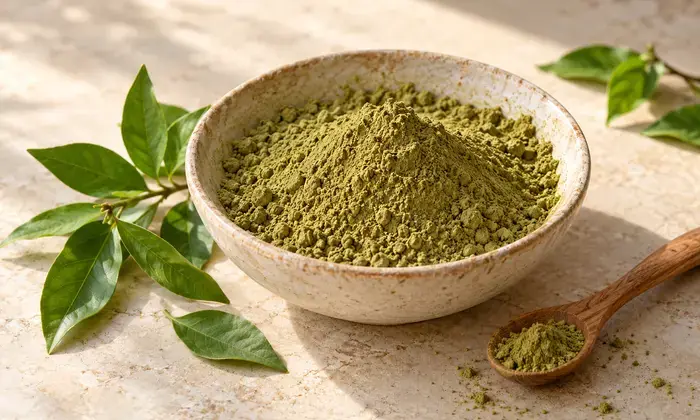
The traditional base consists of dried, ground Lawsonia inermis leaves. This plant contains, among other things, lawsone, the colouring molecule responsible for henna's use on skin and hair. Botanical identification helps establish what the raw material is. It does not, however, describe the entire composition of a ready-to-use cone.
One common mistake is to interpret “natural henna” as necessarily meaning “henna leaves only”. A paste can contain several ingredients while still being described as inspired by a traditional preparation. What matters is checking the full list, not merely the large print on the packaging.
The fineness of the grind also matters for drawing. Oversized plant fragments can block a narrow tip. This is not inherently a safety issue but one of convenience and precision: paste that emerges in fits and starts makes small details difficult.
The liquid: making mixing and shaping possible
Dry powder cannot be used to draw directly like a pencil. A liquid is needed to make a paste. Water can serve this purpose. Some handmade preparations also use other liquids, but you cannot judge a formula's performance from the reputation of one particular ingredient.
It's useful to distinguish the amount of water in a formula from its final quality. Paste that is too runny may spread; paste that is too thick may be difficult to squeeze through an applicator. This article, however, focuses on understanding ingredients, not on providing a recipe or adjusting the consistency. Proportions and methods will be covered in the dedicated preparation guide.
Another detail: an ingredient list tells you what a preparation contains, but not necessarily the entire manufacturing process. Seeing “water” in second place does not reveal the preparation time, mixing date or storage conditions.
Why do some pastes contain sugar?
Sugar appears in various traditional or handmade recipes. Its practical purpose is generally connected with the paste's consistency and adhesion. A preparation intended for drawing must be able to form a smooth line without immediately lifting away from the skin; a slightly pliable, cohesive texture can help.
However, you shouldn't conclude that “more sugar = better henna”. Formulations differ and the final effect depends on the mixture as a whole. An unsuitable proportion can make paste unpleasant to work with. Once again, the label alone cannot predict the quality of the lines you will draw.
Here's a useful example: two pastes may both list sugar, yet one may be easy to handle while the other spreads. Sharing an ingredient doesn't erase differences in preparation. That's why a formula must always be considered as a whole.
Oils and fragrances: beware of simplistic assumptions
Some products contain essential oils or fragrance ingredients. These may contribute a particular scent or play a part in the formulator's technical choices. But “essential oil” does not mean “risk-free”, even when it comes from a plant. Skin can react to a fragrance ingredient; an appropriate formulation must take account of its intended use and conditions of application.
Conversely, the absence of essential oils doesn't automatically make a preparation poor. Recipes and manufacturers' requirements differ. A product with a short ingredient list may be perfectly suited to its purpose; another may require additional agents to be marketed under particular conditions.
When you see “henna oil” on an accessory product, ask what it actually is: something intended for mixing into paste, for use after application, or for another stage? Two bottles with similar names may have different purposes. Labelling and instructions for use take precedence over habits picked up from a video.
What about preservatives, thickeners and colourants?
Paste prepared in advance for sale may raise different questions from paste mixed just before use: stability, shelf life, consistency during transport, microbiological quality and compatibility with the packaging. Depending on its formulation, a manufacturer may use ingredients with different functions. Their presence alone does not establish whether a product is suitable: you need to know which ingredient is involved, at what concentration and for what use.
The clearest point requiring caution concerns added colourants. Natural henna normally produces orange to reddish-brown shades on the skin. The FDA explains that certain products sold as “black henna” may contain PPD, which has been associated with serious allergic reactions. This source relates to the American context and is not enough, by itself, to determine whether a product sold in France complies with French regulations.
Remember: the real warning sign isn't “there are several ingredients”; it's “I can't find out which ingredients are used, even though the product promises a spectacular effect”. Specific products deserve a careful reading of their formulas.
Table: the main ingredient groups
| Ingredient group | Possible function | Useful question |
|---|---|---|
| Lawsonia inermis powder | Supply the colouring plant material | Is this definitely the identified species? |
| Water or another liquid | Form a paste | Is the formula clearly described? |
| Sugar | Contribute to consistency and adhesion | Is it included in a known formulation? |
| Oils / fragrances | Fragrance or a role in preparation | Which specific components are present? |
| Texture / preservation agents | Stability of the finished product | Are the intended use and instructions clear? |
| Added colourants | Change appearance or shade | Which ones, and for what authorised use? |
How to read a real product page in five minutes
Start with the stated use: skin designs, hair treatment or something else. Then check the complete ingredient list; be wary of vague expressions such as “secret formula” when you're trying to assess what is in the product. Look at precautions, storage and information identifying the manufacturer or the person responsible for marketing it. Finally, ask whether the details are consistent with the results promised.
A formula that clearly lists its ingredients may be preferable to an attractive photograph accompanied by unverifiable claims. This doesn't prove that it will produce better designs: it simply gives you more information on which to base an informed choice.
For example, imagine a paste advertised as “black immediately on application”. Don't just ask whether the photograph looks good. First ask what produces that colour. Conversely, for a cone marketed as brown, don't assume the word “brown” necessarily indicates a pure formula: the ingredient list remains your reference.
If you'd like to learn how to make a preparation yourself, see our guide to the recipe and its stages. And if your question concerns the final colour on the skin, our existing guides “Why Isn't My Henna Staining?” and “Black Henna: Is It Dangerous?” cover these matters in greater detail.
FAQ
Can henna paste contain only powder and water?
Some simple preparations use these ingredients, but their performance when drawing can vary. The precise formula depends on the intended use.
Is sugar used to make the design darker?
In various preparations, its role is primarily discussed in terms of texture and adhesion. Sugar alone does not allow you to predict the final intensity of a design.
Are essential oils indispensable?
No. There are different approaches to formulation. If they are present, the important thing is to check the ingredients and precautions for use.
Is a pleasant-smelling paste better quality?
No. A pleasant scent may come from fragrance components; it proves neither the purity nor the performance of the formula.
Why do some cones have long ingredient lists?
A commercial ready-to-use preparation may contain several ingredients related to stability or texture. What matters is that the composition is clear and suitable for the stated purpose.
Sources
- Kew: https://powo.science.kew.org/taxon/urn%3Alsid%3Aipni.org%3Anames%3A553638-1/general-information
- Review of lawsone, PubMed: https://pmc.ncbi.nlm.nih.gov/articles/PMC11288359/ (chemical basis of the dye; do not reproduce medical claims)
- FDA, temporary henna and added dyes: https://www.fda.gov/cosmetics/cosmetic-products/temporary-tattoos-hennamehndi-and-black-henna-fact-sheet