
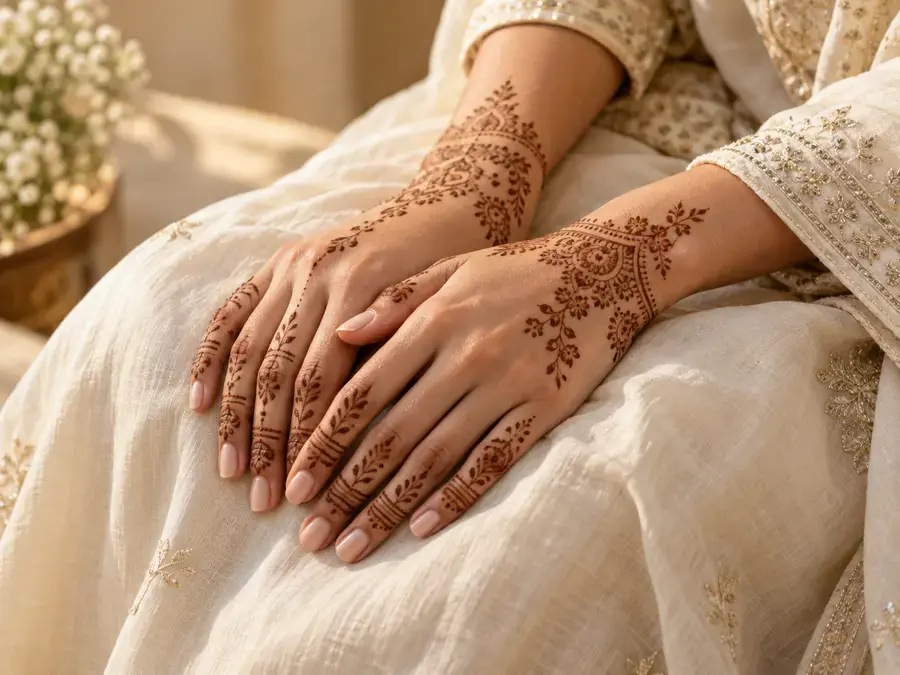
You come across two photographs of decorated hands. In the first, the designs have a reddish-brown hue; in the second, the lines look very dark blue, almost black. Both designs are temporary, and marketing descriptions sometimes emphasise their plant-based origins. Yet they aren't necessarily the same product. Henna and jagua come from two different plants, with different colouring compounds and distinct visual results.
Before choosing a preparation, it's important to know what you're actually looking at. This guide isn't about labelling one plant “good” and the other “bad”, but about helping you recognise their differences and understand why the word “natural” alone is not enough to assess a product intended for the skin.
Two names often found together in shops, but two botanically distinct plants
Traditional henna comes from the leaves of Lawsonia inermis. This shrub belongs to the Lythraceae family, and its leaves contain lawsone, among other compounds, a pigment associated with orange and reddish-brown stains. The plant features in many traditions of skin decoration and hair colouring.
Jagua, on the other hand, is associated with Genipa americana, a tropical tree native to much of tropical America. Preparations derived from its fruit are used to produce dark temporary stains on the skin. Its characteristic colouring effect is linked in particular to genipin and the transformations this compound undergoes during the staining process.
Here's the first essential distinction: jagua is not a black variety of Lawsonia inermis. Nor is it “black henna” in the botanical sense. When you encounter “jagua henna” on a product page, check the actual composition instead of assuming it is a standard mixture.
Colour: the most visible difference
Natural henna normally produces an orange, orange-brown or reddish-brown stain on the skin, depending on preparation, application and the area of the body. This warm colour palette gives it a distinctive appearance: even a delicate pattern retains a softness and a strong association with mehndi traditions.
Jagua is sought after for its cooler tones, ranging from dark blue to bluish-black. From a distance, some designs can resemble black ink. Nevertheless, the term “permanent tattoo” should be avoided: this type of staining is temporary and fades as the skin renews itself.
This explains why two identical designs can create different impressions: a small floral branch drawn in henna often looks softer, whereas the same pattern in jagua may offer a stronger visual contrast. This is a matter of aesthetic preference, not a ranking of quality.
Why doesn't a design show its final colour immediately?
With henna, the shade seen immediately after removing the paste may develop over the following hours. The final outcome depends on several conditions. With jagua, the dark stain may also develop gradually after application, depending on the preparation used.
An advertisement that only shows the final result, without saying when the photograph was taken, may therefore give an incomplete impression. When comparing two products, don't look solely at an edited image or a dramatic before-and-after photograph. Look for the manufacturer's actual instructions and stated limitations.
You should also treat the duration advertised on the packaging with caution: the area of the body, friction, washing, formulation and natural skin renewal all affect how a design looks over time. Our existing article “How Long Does a Henna Tattoo Last?” explores this question for henna; this guide doesn't turn longevity into a competition between products.
“Plant-based” doesn't mean “allergic reactions are impossible”
Both materials are plant-derived, but that doesn't guarantee that they suit every person's skin. This is especially important with jagua: medical publications have described allergic contact dermatitis linked to genipin in certain Genipa americana preparations. These cases don't imply that everyone will react, but they are enough to disprove the idea that a plant extract is automatically risk-free.
It's also important to distinguish jagua from products sold as “black henna” containing added dyes such as PPD. The US FDA describes sometimes serious reactions associated with some “black henna” products. But a dark design, on its own, doesn't identify the substance used. It's the ingredients, not just the colour, that tell you what you're buying.
If an application causes a skin reaction, stop using the product and seek appropriate medical advice. This brief reminder is not a substitute for Hennediscount's specialist guides on black henna and allergies.
[KEY POINT CALLOUT: “Jagua ≠ natural henna ≠ PPD-containing black henna”. Three terms that must be distinguished by their ingredients, not their photographs.]
The aesthetic choice: what effect do you want?
If you enjoy classic mehndi compositions, delicate flowing patterns, flowers and warm contrasts, natural henna shades fit that aesthetic well. If you're looking for a darker temporary design with a graphic effect resembling an ink line, you may be interested in jagua's appearance.
However, the choice isn't solely about colour. A product's consistency, the precision of its tip and the manufacturer's instructions also affect the outcome. A dark material that's difficult to handle won't necessarily produce a more elegant design than henna paste that's pleasant to work with.
Consider the area of the body, too: a photograph taken on a palm cannot predict precisely the same shade on a forearm. To assess a result, compare examples made on similar areas, under comparable lighting and without misleading filters whenever possible.
Table: henna and jagua at a glance
| Feature | Traditional henna | Jagua |
|---|---|---|
| Main plant | Lawsonia inermis | Genipa americana |
| Part commonly used | Ground leaves | Fruit-derived preparation |
| Associated colouring compound | Lawsone | Genipin / colouring derivatives |
| Typical result | Orange to reddish-brown | Dark blue to bluish-black |
| Visual traditions | Mehndi and various traditions | Dark temporary designs, tropical traditions and modern uses |
| Plant-derived | Yes | Yes |
| Automatically guaranteed to be safe | No | No |
| Interchangeable product | No | No |
This table compares the reference plant materials. Commercial preparations may contain other ingredients, so always read the labels.
Three common mistakes when comparing them
First mistake: assuming jagua is simply a new henna colour. It's a different plant; this botanical distinction affects both ingredients and what you should expect.
Second mistake: believing that a blue-black result necessarily proves the presence of PPD. Jagua can produce this sort of shade without being PPD-containing henna, but only a product's formula can tell you what it contains.
Third mistake: judging exclusively from photographs. Editing, lighting, the time elapsed after application and the area of skin stained all change the visual impression. A good product page should provide clear information beyond attractive images.
How to make an informed choice
Start by identifying the plant and the ingredients. Next, check the intended use, directions and precautions. Only then ask yourself the aesthetic question: do you want a traditional warm-toned stain or a darker temporary design? Following this order prevents you from choosing the colour in a photograph only to discover afterwards that the product isn't what you imagined.
To explore the world of henna in greater depth, visit our pillar page covering the basics. For precautions specifically related to black henna, read our existing dedicated article. There's no obligation to buy anything: what matters is understanding the materials before making a decision.
FAQ
Is jagua natural black henna?
No. Jagua comes from Genipa americana, a different plant. The two products have different staining characteristics.
Does jagua necessarily contain PPD?
No, not by definition. However, the composition of any commercial preparation must be checked: its colour alone isn't enough to identify it.
Why isn't henna naturally blue-black?
Its main colouring compound, lawsone, is associated with orange and reddish-brown shades on the skin.
Can a jagua product cause an allergic reaction?
Yes. Cases of allergic contact dermatitis linked to genipin have been reported in the medical literature. This does not establish how frequently such reactions occur across all products.
Can henna and jagua be mixed to obtain a particular shade?
This isn't something to experiment with casually. Mixing products changes their composition and how they are used; follow the manufacturer's directions and avoid unverified recipes.
Verifiable external sources
- Kew, Lawsonia inermis: https://powo.science.kew.org/taxon/urn%3Alsid%3Aipni.org%3Anames%3A553638-1/general-information
- Kew, Genipa americana: https://powo.science.kew.org/taxon/751331-1
- PubMed, documented case of genipin allergy in a jagua tattoo: https://pubmed.ncbi.nlm.nih.gov/28675523/
- FDA, henna and so-called “black henna” formulations: https://www.fda.gov/cosmetics/cosmetic-products/temporary-tattoos-hennamehndi-and-black-henna-fact-sheet